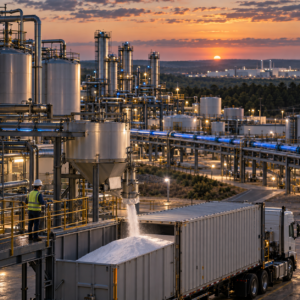

Smackover Lithium’s Preliminary Economic Assessment for the Franklin Project in East Texas outlines a potential large-scale lithium operation with US$5.0 billion in after-tax NPV, a 24% IRR and production capacity of up to 70,000 tonnes of battery-quality lithium carbonate per year.
The project would require approximately US$3.5 billion in initial capital, with estimated average cash operating costs of US$4,226 per tonne and all-in costs of US$5,054 per tonne.
For the Direct Lithium Extraction (DLE) sector, the significance of the assessment lies in the scale of the proposed operation and the use of a DLE process already being advanced through Smackover Lithium’s South West Arkansas project.
A 70,000-Tonne DLE Development
The Franklin PEA models a 20-year operating period with average lithium carbonate production of approximately 64,600 tonnes per year, reaching a potential annual capacity of 70,000 tonnes.
The project is based on an average lithium concentration of 515 mg/L over the modelled operating life, with an average brine flow rate of approximately 455,000 barrels per day.
Initial production could begin in the early 2030s, subject to further technical work, permitting, financing and project development.
The scale places Franklin among the more significant proposed DLE projects in North America.
Economics Provide the Key Commercial Test The PEA estimates:
● US$4.99 billion after-tax NPV at an 8% discount rate
● 24% after-tax IRR
● 3.1-year after-tax payback
● US$3.50 billion initial CAPEX
● US$4,226/t average cash operating cost
● US$5,054/t average all-in cost
● 70,000 tpa maximum lithium carbonate capacity
The economic model assumes a lithium carbonate selling price of US$22,400 per tonne over the project life.
The project economics are particularly sensitive to lithium prices and the production schedule, making market conditions a major factor in future investment decisions.
Importantly, the PEA remains preliminary. It includes Inferred Mineral Resources, which are considered too speculative to support the same level of economic certainty as Mineral Reserves.
Resource Expansion Adds Strategic Value The updated resource estimate strengthens the underlying resource position.
The project now includes an Indicated Mineral Resource of 1.77 million tonnes of lithium carbonate equivalent at an average lithium concentration of 562 mg/L, alongside an Inferred Resource of 2.13 million tonnes LCE at an average concentration of 572 mg/L.
The resource also contains significant bromide and potassium potential.
The PEA identifies approximately 3.15 million tonnes of inferred bromide and 15.06 million tonnes of inferred potash, although neither is included in the core lithium economic case.
This creates potential optionality beyond lithium.
The company is evaluating a potential bromine operation of approximately 50,000 tonnes per year, while potash remains a longer-term opportunity requiring further technical and economic assessment.
DLE Technology Can Be Replicated Across the Smackover
A notable feature of the Franklin development strategy is its reliance on process knowledge from the company’s South West Arkansas Project.
The brines at Franklin are considered sufficiently similar to those at South West Arkansas to allow key elements of the existing DLE flowsheet and cost structure to be applied to the East Texas project.
Testing of Franklin brine using a lithium-selective sorption process reportedly achieved target lithium retention while also achieving targeted rejection of sodium, potassium, calcium and magnesium.
This approach could reduce some of the technology and process-development risk associated with developing a new DLE operation from the ground up.
It also illustrates an important commercial advantage for DLE developers operating across multiple resources: a proven process can potentially be replicated and adapted across geographically connected brine assets.
Existing Infrastructure Could Support Development
The Franklin Project is located across Hopkins, Franklin and Titus counties in East Texas, close to Mount Vernon.
The area has an established history of oil and gas development, leaving substantial subsurface and surface infrastructure across the broader region.
The project also has access to interstate highways and the national rail network.
For a large-scale DLE development, proximity to existing infrastructure could influence both construction requirements and operating economics.
The integration of lithium production with established energy infrastructure is also becoming an increasingly relevant development model for US critical mineral projects.
The Next Milestone Is the PFS
The partnership plans to advance Franklin toward a Preliminary Feasibility Study in 2027.
The next phase will focus on further defining the Upper and Middle Smackover aquifers, refining brine chemistry, advancing DLE testing and evaluating the potential recovery of bromine and potash.
For investors and strategic customers, the transition from PEA to PFS will be important.
It should provide greater clarity around resource definition, process performance, capital requirements, operating costs and project execution.
What Franklin Means for DLE
Franklin illustrates the changing investment threshold for DLE projects.
The critical question is no longer whether lithium can be selectively extracted from brine in principle. Developers now need to demonstrate that the technology can support large production volumes, predictable operating costs and sufficient project returns to justify multi-billion-dollar investment.
Franklin’s PEA provides an early economic case for that model, while its next development stages will determine how much of that potential can ultimately be converted into a financeable project.
For the wider DLE market, the key metrics to watch are therefore production scale, CAPEX per tonne, operating cost, resource quality, process recovery, product qualification and the ability to secure long-term customers.